Dose Quantities and Units
What is a quantity, what is a unit?
A quantity is something that is measured – everyday examples of quantities are weight, distance and time. A unit, on the other hand, is how the quantity is expressed. Using weight as an example, various units could be used, including grams, pounds and tonnes (and many others).
So for example, if two points are described as being 100 metres apart, the quantity is distance, and the unit is metres.

Dose is a measure of the quantity of energy deposited in tissue by the radiation as it passes through the body. For X-ray security cabinets there are two quantities to consider. Equivalent dose is used in relation to the dose to a single organ such as the skin, or to extremities (such as the hands). Effective dose is used in relation to a whole-body dose.
Units
The unit for both effective dose and equivalent dose is the sievert, Sv.

A dose of 1 Sv is enough to cause radiation injuries and is a high dose in the context of radiation work. While doses of one or two sieverts could result from incidents or accidents, routine daily or monthly doses to radiation workers will be very much less, perhaps thousandths or millionths of a sievert.
In practice, fractions of sieverts are used to measure dose, so it is important to understand the prefixes that are used. The table below explains the different prefixes.
| 1 µSv | 1 microsievert (millionth) | 1 / 1,000,000 |
| 1 mSv | 1 millisievert (thousandth) | 1 / 1,000 |

An important concept in practical radiation protection is that of dose rate. This is a measure of how quickly a dose of radiation is received and is expressed as radiation dose over a given unit of time, normally an hour.
For example, if we use a familiar analogy like driving at 100 km/hr in your car, then after driving for 1 hour you will have travelled 100 km.
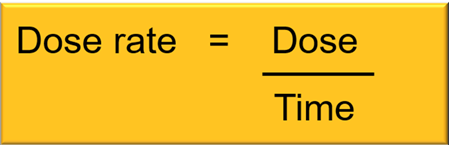
If you are standing in a radiation field of 100 µSv/h, then after 2 hours you will have received a dose of 200 µSv.
Dose rate is normally expressed in terms of microsieverts per hour (μSv/h) or millisieverts per hour (mSv/h).
Radiation Protection Supervisor: Security Cabinet Operator

Radiation Protection Supervisor: Security Cabinet Operator